



Common Causes of Overhead Cable Failure and Prevention Strategies
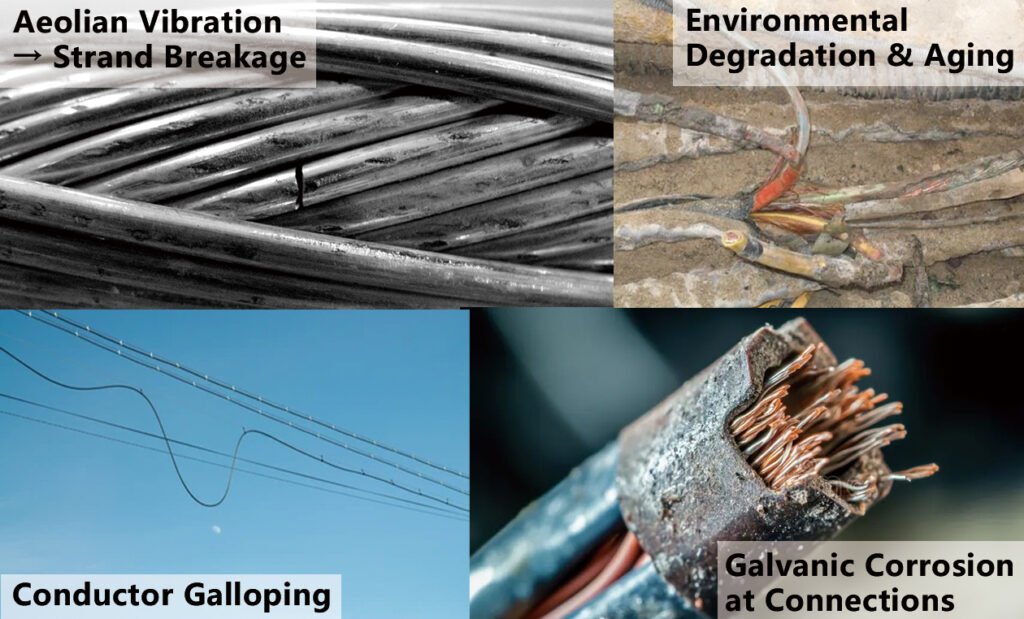
Overhead power line failures typically stem from mechanical stress, environmental degradation, and electrical overstress. The primary technical culprits include aeolian vibration leading to fatigue in conductors like ACSR, thermal aging of insulation in ABC (Aerial Bundled Cables), and galvanic corrosion at connection points. Prevention requires a combination of strict adherence to IEC 60826 (Design criteria of overhead transmission lines) and the implementation of vibration dampers, proper tensioning, and high-quality material selection (e.g., using greased cores for ACSR in high-salinity environments). Regular thermographic inspections are essential to identify localized overheating before a catastrophic dielectric or mechanical breakdown occurs.
Technical Comparison of Overhead Conductor Vulnerabilities
The following matrix compares common overhead cable types and their specific failure modes under standard operating conditions.
| Conductor/Cable Type | Primary Material | Standard | Main Failure Cause | Preventive Measure |
| ACSR | Aluminum / Steel | IEC 61089 | Aeolian Vibration / Core Corrosion | Stockbridge Dampers / Greased Core |
| AAAC | Aluminum Alloy | EN 50183 | Sagging / Tensile Fatigue | Precise Tensioning / Pre-stressing |
| ABC (LV/MV) | XLPE / Aluminum | NF C 33-209 | UV Degradation / Tracking | Carbon Black Loading (>2%) |
| AAC | All Aluminum | ASTM B231 | Low Tensile Strength / Stretching | Short Span lengths only |
Environmental and Mechanical Stress Factors
UV and Thermal Degradation in Aerial Bundled Cables (ABC)
Insulated overhead cables (ABC) are prone to insulation cracking due to prolonged UV exposure and thermal cycling. Standard XLPE (Cross-linked Polyethylene) used in these applications must contain a minimum of 2.5% Carbon Black to ensure UV stability. Exceeding the 90°C continuous operating temperature accelerates molecular chain scission, leading to brittle insulation and subsequent phase-to-phase faults.
Aeolian Vibration and Galloping
High-frequency, low-amplitude aeolian vibrations (3-150 Hz) induce fatigue at the conductor’s support points. Over time, this leads to individual strand breakage in ACSR (Aluminum Conductor Steel Reinforced). Conversely, galloping—a low-frequency, high-amplitude oscillation caused by ice accretion—can lead to structural tower failure or “clashing” (mid-span short circuits). Prevention involves the use of interphase spacers and aerodynamic drag dampers.
Electrical Faults and Industry Standards
Dielectric Breakdown and Tracking
In Medium Voltage (MV) overhead systems, surface tracking occurs when contaminants (salt, dust) combine with moisture on the cable surface. This creates a conductive path that erodes the jacket. Adhering to IEC 60502-2 for cable construction and ensuring leakage distance on insulators meets local pollution levels (as per IEC 60815) is critical.
Lightning and Surge Protection
Overhead lines act as massive antennas for atmospheric discharges. Protection requires:
- Shield Wires: Correct placement of overhead ground wires (OPGW or galvanized steel) to provide a shielding angle of $<30^{\circ}$.
- Grounding Resistance: Maintaining a tower footing resistance of <10 Ohms to ensure rapid dissipation of surge currents, preventing “back-flashover” to the phase conductors.