

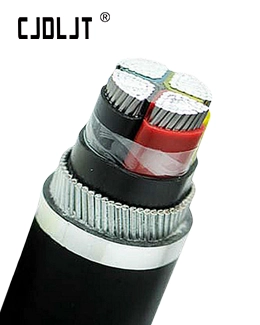
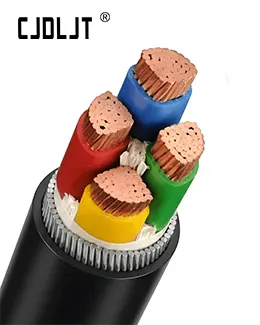
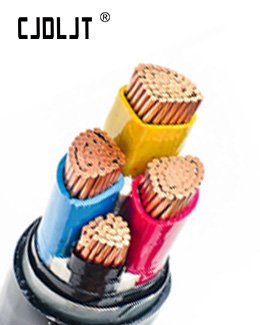
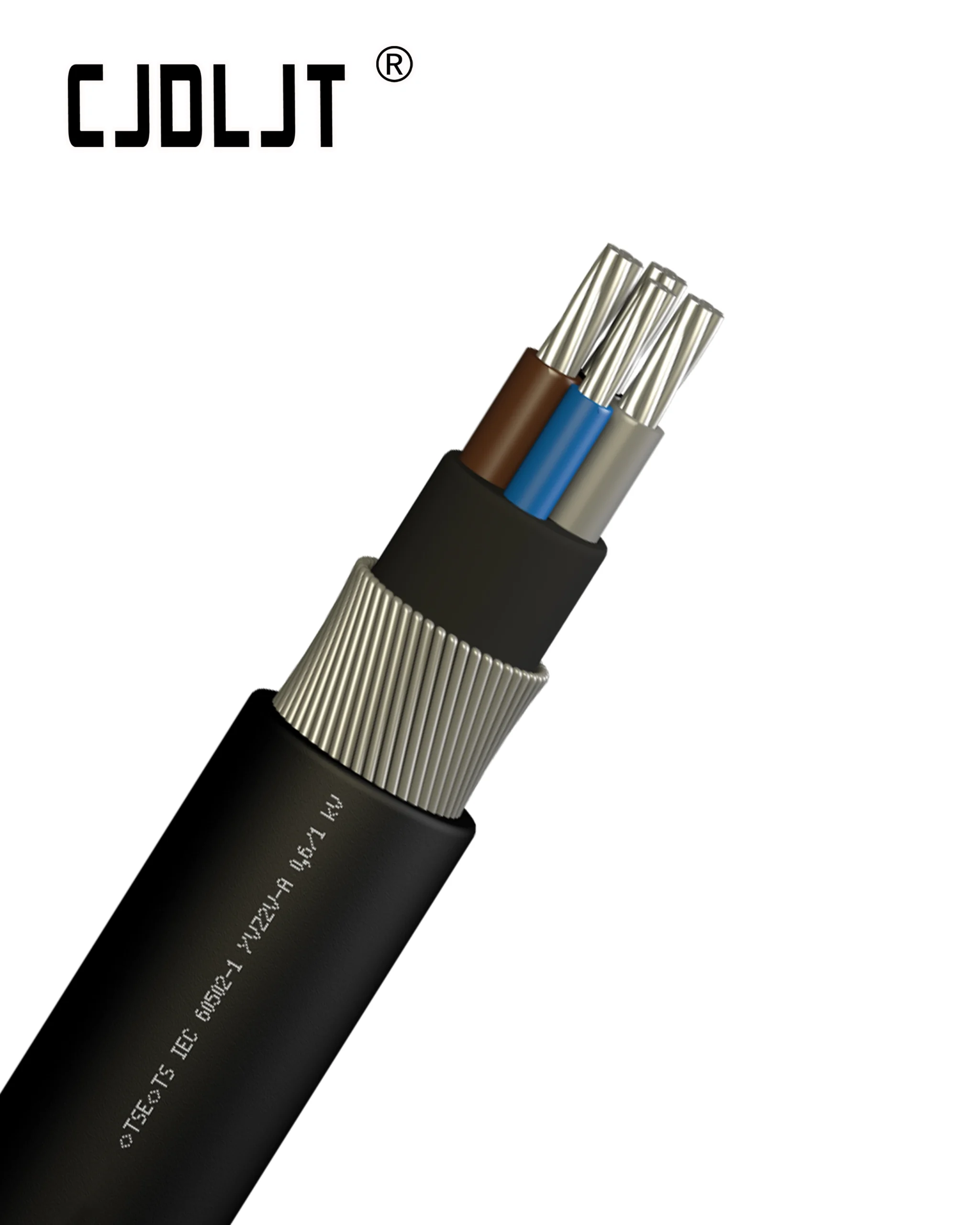

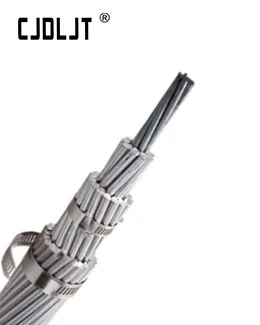
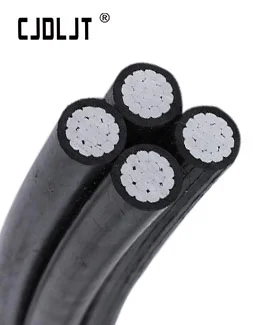
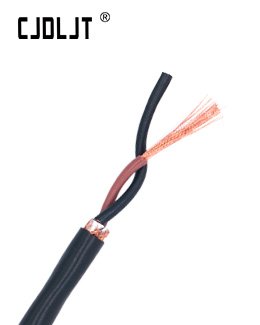

Aluminium conductor XLPE SWA cables (such as NA2XRY) should be selected instead of copper when the project prioritizes lower material cost, reduced cable weight, and large conductor cross-sections for long-distance or high-current low-voltage distribution, while still meeting the thermal and mechanical requirements of IEC 60502-1. These cables use aluminium Class 1 or Class 2 conductors, XLPE insulation rated 90 °C continuous / 250 °C short-circuit, galvanised steel-wire armour (SWA), and a PVC outer sheath at 0.6/1 kV. They are technically suitable whenever the slightly larger overall diameter and lower conductivity of aluminium are acceptable after proper sizing.
Technical Parameter Comparison Matrix: Aluminium vs Copper XLPE SWA Cables
| Parameter | Aluminium XLPE SWA (e.g. NA2XRY) | Copper XLPE SWA (e.g. N2XRY) |
|---|---|---|
| Conductor Material | Aluminium (IEC 60228 Class 1/2) | Annealed Copper (IEC 60228 Class 1/2) |
| Conductivity (% IACS) | ≈ 61 % | 100 % |
| Continuous Operating Temperature | 90 °C | 90 °C |
| Short-Circuit Temperature (5 s) | 250 °C | 250 °C |
| Typical Weight Advantage | 40–50 % lighter | Heavier baseline |
| Material Cost | Significantly lower | Higher |
| Overall Diameter (same ampacity) | Larger | Smaller |
| Armour Type | Galvanised Steel Wire Armour (SWA) | Galvanised Steel Wire Armour (SWA) |
| Rated Voltage | 0.6/1 kV | 0.6/1 kV |
| Standard | IEC 60502-1 | IEC 60502-1 |
Electrical and Thermal Performance Considerations
Aluminium has approximately 61 % of the conductivity of copper. To achieve the same current-carrying capacity, a larger aluminium cross-section is required (commonly two steps larger in standard sizing tables). Once correctly sized, the XLPE insulation provides identical temperature ratings (90 °C continuous, 250 °C short-circuit) for both materials. Voltage drop and short-circuit withstand must be recalculated using the higher resistivity and specific heat capacity of aluminium.
Mechanical and Installation Advantages
The lower density of aluminium results in a cable that is typically 40–50 % lighter than the copper equivalent. This reduces pulling tension, simplifies handling on site, and lowers transportation costs. Steel-wire armour (SWA) still provides the necessary tensile strength for direct burial or tray installation. The larger overall diameter of aluminium cables must be checked against duct sizes, gland sizes, and bending radius limitations.
Cost and Project Economics
Material cost is the primary driver for selecting aluminium. On projects with long feeder lengths or large conductor sizes (typically above 95 mm² or 120 mm²), the cost saving is substantial. Life-cycle cost analysis should also include the slightly higher energy losses due to increased resistance, although for many industrial and utility LV networks the capital saving outweighs the operational difference.
Application Guidelines
Select aluminium conductor XLPE SWA (NA2XRY type) when:
- The installation is fixed and long-term (no frequent flexing)
- Weight reduction or cost control is critical
- Adequate space exists for the larger cable diameter
- Termination practices for aluminium (proper oxide removal, compatible lugs, and anti-oxidant compound) can be controlled
Prefer copper conductor XLPE SWA when:
- Space is restricted
- Maximum ampacity in a given diameter is required
- Termination simplicity and long-term connection reliability are prioritised
- The circuit is subject to frequent movement or vibration
Compliance and Best Practice
Both aluminium and copper versions fully comply with IEC 60502-1. When specifying aluminium, always confirm the conductor class, compaction, and jointing method with the cable manufacturer and the termination hardware supplier. Correct installation practices eliminate the historical concerns associated with aluminium terminations.
Choose aluminium conductor XLPE SWA cables when cost and weight savings are decisive and the circuit can accommodate the larger cross-section required for equivalent performance. For the majority of fixed industrial and infrastructure LV power distribution projects, properly sized NA2XRY-type cables offer a technically sound and economically attractive solution.
References
- IEC 60502-1:2021, Power cables with extruded insulation and their accessories for rated voltages from 1 kV (Um = 1.2 kV) up to 30 kV (Um = 36 kV) – Part 1: Cables for rated voltages of 1 kV (Um = 1.2 kV) and 3 kV (Um = 3.6 kV). International Electrotechnical Commission.
- IEC 60228:2004, Conductors of insulated cables. International Electrotechnical Commission.
- IEC 60287-1-1:2006 (and amendments), Electric cables – Calculation of the current rating – Part 1-1: Current rating equations (100 % load factor) and calculation of losses – General. International Electrotechnical Commission.
- IEC 60811 series, Electric and optical fibre cables – Test methods for non-metallic materials (relevant parts for XLPE and PVC compounds).
- BS EN 60228 / BS 6360 (historical reference for conductor classes, now aligned with IEC 60228).