



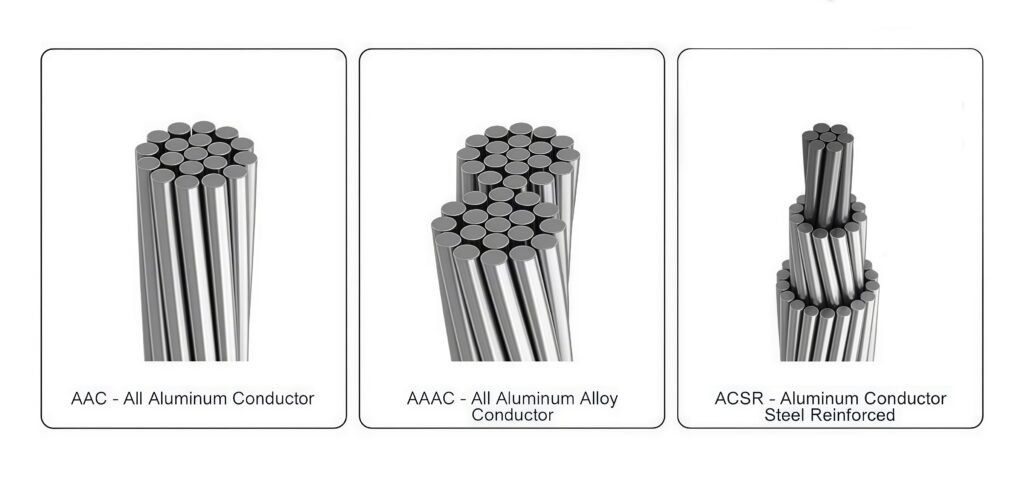
ACSR consists of aluminum strands around a central galvanized steel core, delivering high tensile strength for long-span overhead lines; the steel core resists wind, ice, and sag while the aluminum strands carry the current.
AAC (All-Al Aluminum Conductor) is all aluminum with no steel core, offering higher ampacity per cross-section but lower mechanical strength, which limits span length.
AAAC uses aluminum alloy strands (no steel core) to improve strength-to-weight over AAC, with good sag control but slightly lower conductivity than AAC.
All three are uninsulated and used on overhead networks; ACSR excels in long, heavily loaded spans, while AAC/AAAC suit shorter or moderate spans needing higher conductivity.
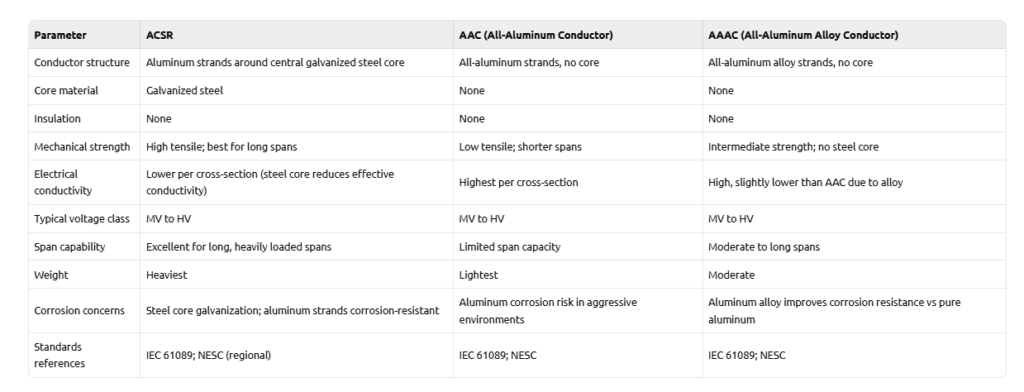
Data Matrix (Technical Snapshot)
SOP / Checklist (Selection, Installation, Testing)
1.Define service voltage and span requirements
Confirm line voltage class (MV/HV) and target maximum span length.
Assess terrain, wind, ice loading, and available supports.
2.Choose conductor family based on span and strength needs
If long spans and heavy loading are expected, prefer ACSR.
If high conductivity and moderate spans suffice, consider AAC.
If you need improved strength without a steel core, consider AAAC.
3.Evaluate mechanical design parameters
Determine Minimum Breaking Load (MBL) and allowable tension per span.
Specify cross-section, core size (for ACSR), and strand count to meet sag requirements.
4.Plan routing, supports, and terminations
Verify pole/tower heights, guying, anchor points, spacers/messengers.
Ensure compatible termination kits for the chosen conductor.
5.Installation considerations
Use proper pulling techniques; avoid sharp bends; apply sag-to-span guidelines.
Observe minimum bend radii (typical: 12x–15x conductor diameter).
6.Inspections and testing plan
Visual inspection for damaged strands, corrosion, and coatings.
Electrical tests per regional practice (continuity, resistance) after installation.
7.Commissioning and documentation
Verify sag, tension, clearance, and phase identification post-installation.
Document route, cross-sections, MBLs, and maintenance schedules.
8.Regional standards and part-number guidance
Reference IEC 61089 and local codes (e.g., NESC) for final selection.
Verify supplier part numbers and hardware compatibility.
In summary
ACSR, AAC, and AAAC each serve distinct roles in overhead power transmission and distribution.
ACSR remains the preferred choice for long spans and heavy mechanical loads thanks to its steel-reinforced strength, while AAC delivers superior conductivity for shorter, less demanding routes.
AAAC fills the middle ground with enhanced strength-to-weight and corrosion resistance without a steel core. By aligning conductor selection with span length, loading conditions, electrical requirements, and relevant industry standards, engineers and project teams can ensure reliable, efficient, and cost-effective overhead line performance throughout its service life.