



AS/NZS 3560.1 ABC Cable Specifications
AS/NZS 3560.1 specifies the requirements for Aerial Bundled Cables (ABC) with cross-linked polyethylene (XLPE) insulation for seasoned overhead distribution systems, specifically rated for voltages up to and including 0.6/1 (1.2) kV. Part 1 (P1) focuses explicitly on Aluminum Conductors. In this standard, ABC cable stands for a bundled assembly of insulated phase conductors twisted around a neutral conductor. The phase cores are made of hard-drawn 1350 aluminum, insulated with carbon-black-filled, weather-resistant XLPE capable of handling a continuous operating temperature of 90°C and short-circuit thresholds up to 250°C.
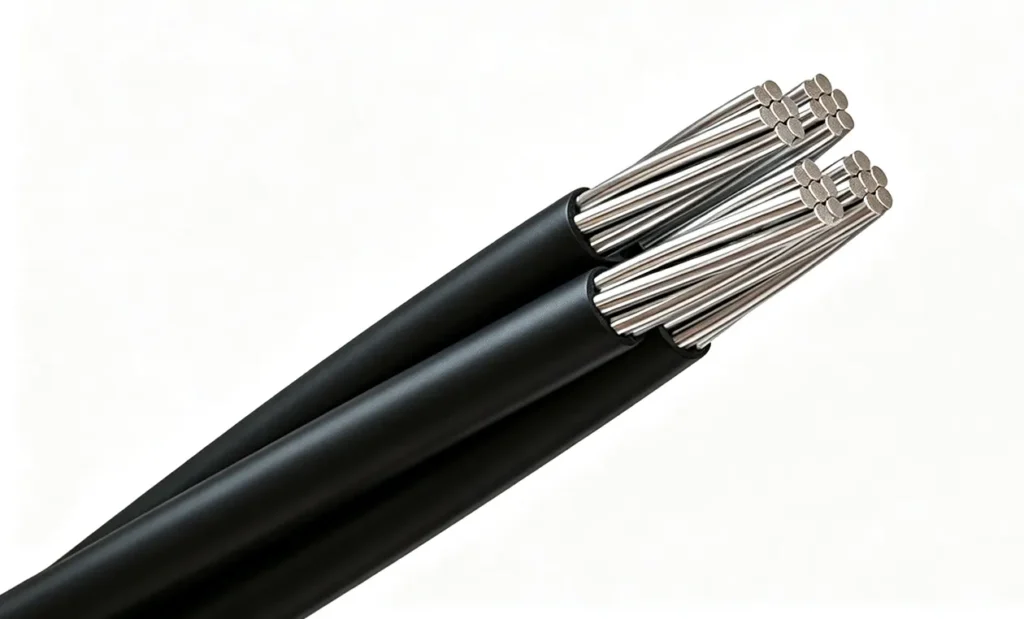
Technical Parameter Matrix (0.6/1 kV ABC to AS/NZS 3560.1)
The matrix below outlines the critical mechanical, electrical, and material specifications for standard cross-sections defined under the AS/NZS 3560.1 standard.
| Technical Parameter | Phase Conductor Specification | Neutral Conductor Specification (Supporting) |
| Conductor Material | Hard-drawn Aluminum (1350) | Aluminum Alloy (6201-T81) or Circular Aluminum |
| Insulation Material | Carbon-black Filled XLPE | Carbon-black Filled XLPE |
| Rated Voltage ($U_0/U$) | 0.6/1 kV | 0.6/1 kV |
| Max. Continuous Operating Temp. | 90°C | 90°C |
| Max. Short-Circuit Temp. (5s) | 250°C | 250°C |
| UV Resistance Standard | Carbon Black Content ≥ 2.0% | Carbon Black Content ≥ 2.0% |
| Core Identification | Permanent Embossed Ribs (1, 2, 3) | Continuous Dominant Ribs / Text Marking |
Core Structural Configurations
Self-Supporting Configurations
In self-supporting systems, all phase and neutral conductors share the mechanical load equally. These assemblies consist of 2 to 4 cores of equal cross-sectional area, typically manufactured from hard-drawn 1350 aluminum, optimized for short-span urban distribution network applications.
Supporting Neutral Core Configurations
This variant utilizes a high-strength aluminum alloy (6201-T81) neutral messenger core designed to bear the total mechanical tensile load of the span. The insulated phase conductors are wrapped around this structural messenger core, preventing electrical conductors from experiencing mechanical stress over long-span configurations.