

Criteria for Determining Water Tree and Electrical Tree Aging
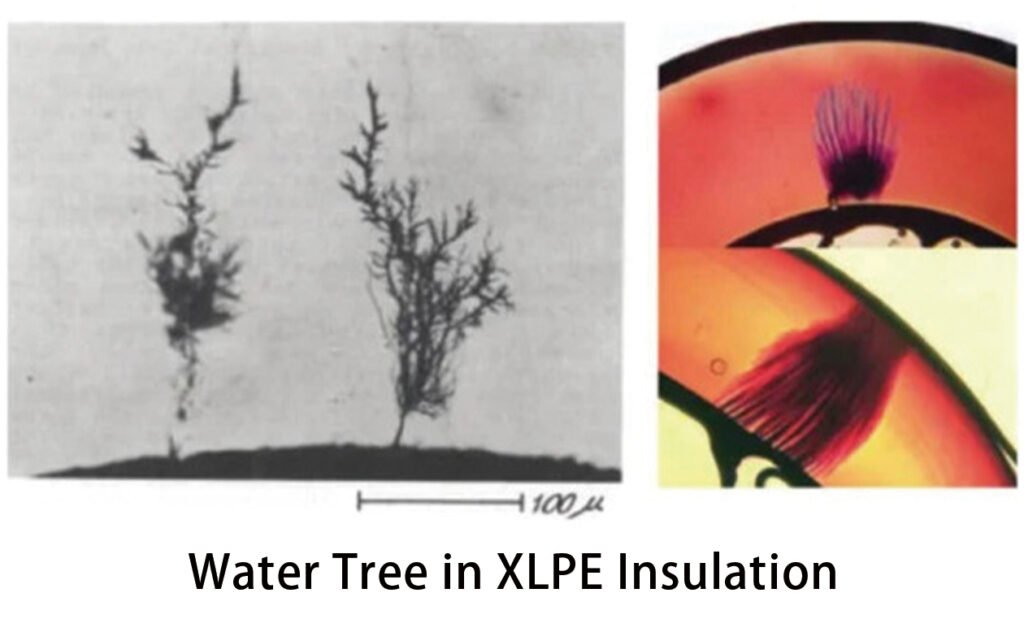
Aging in Medium and High Voltage (MV/HV) XLPE cables is primarily assessed through the detection of Water Trees and Electrical Trees, which represent distinct degradation phases. Water treeing is a pre-breakdown phenomenon occurring in the presence of moisture and an electric field, characterized by microscopic, diffuse “bush-like” structures that reduce the dielectric strength of the insulation over years. In contrast, Electrical Trees are the immediate precursor to insulation failure; they consist of hollow, carbonized channels formed by partial discharges (PD). Determining aging involves measuring Tan $\delta$ (Dielectric Loss Factor), Partial Discharge (PD) levels, and microscopic examination of insulation slices to identify length and density of the tree structures.
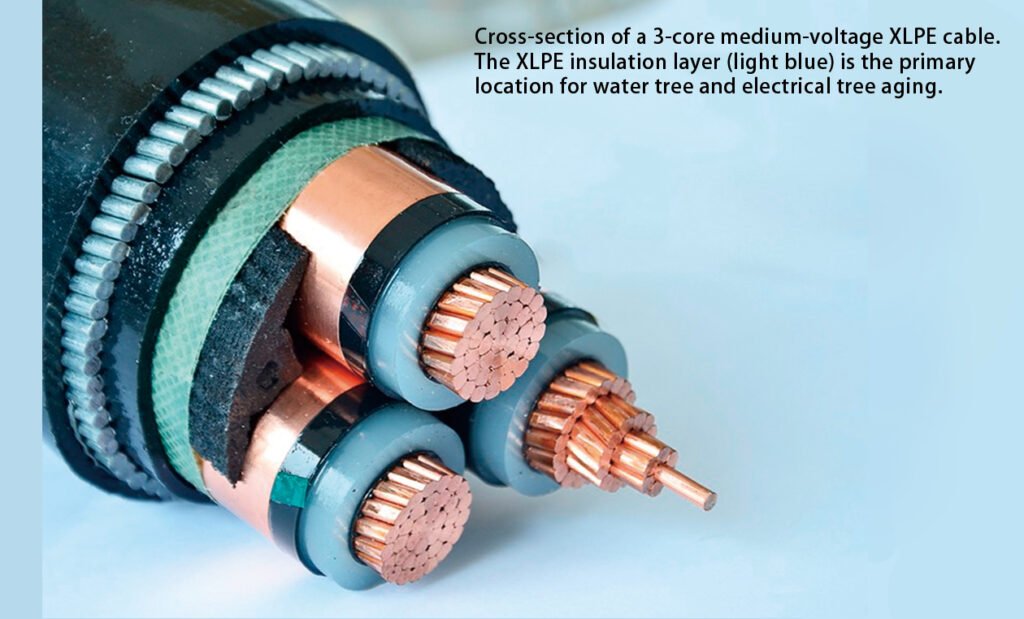
Technical Comparison: Water Tree vs. Electrical Tree Aging
The following table differentiates the physical and electrical parameters used to categorize these two aging mechanisms in cross-linked polyethylene (XLPE) cables.
| Feature | Water Tree Aging | Electrical Tree Aging |
| Initiation Factor | Moisture + Electric Field + Impurities | High Local Field + Gas Voids/Defects |
| Physical Structure | Microscopic, fluid-filled micro-voids | Hollow, carbonized branching channels |
| PD Detection | Generally undetectable (Non-destructive) | High PD activity (typically >5-10 pC) |
| Electrical Impact | Gradual decrease in $U_o$ (breakdown voltage) | Rapid breakdown within hours/days |
| Primary Indicator | Increased Tan $\delta$ and Capacitance | PD Magnitude and Phase-Resolved Patterns |
| Reversibility | Partially “dried out” but damage remains | Irreversible; leads to total failure |
Modular Summary of Degradation Indicators
Water Tree Indicators
- Tan Delta ($ \tan \delta $): High sensitivity to diffuse moisture-related aging.
- Harmonic Current Component: Presence of a 3rd harmonic in the leakage current indicates non-linear deterioration.
- Isothermal Relaxation Current (IRC): Used to calculate the “aging factor” based on trapped charge release.
Electrical Tree Indicators
- Phase-Resolved Partial Discharge (PRPD): Characteristic “wing” patterns indicating internal void discharge.
- Visual Carbonization: Dendritic paths originating from the semi-conductive screen or internal contaminants.
- Acoustic Emission: High-frequency sound waves generated by rapid tree growth in high-stress areas.