



Mitigating Cable Overheating via Optimal XLPE Insulation Selection
Cable overheating occurs when current-induced I²R ohmic losses exceed the thermal dissipation capacity of the cable assembly and its installation environment. Cross-linked polyethylene (XLPE) directly mitigates this risk by converting thermoplastic polyethylene into a thermoset polymer through chemical or physical cross-linking. According to IEC 60502-1 and BS 5467, this molecular structure elevates the maximum continuous conductor operating temperature from 70°C (standard PVC) to 90°C, allows emergency overload thresholds up to 130°C, and prevents deformation during short-circuit thermal transients up to 250°C. Selecting the precise XLPE variant based on voltage rating, installation depth, and thermal resistivity is critical to maintaining system integrity.
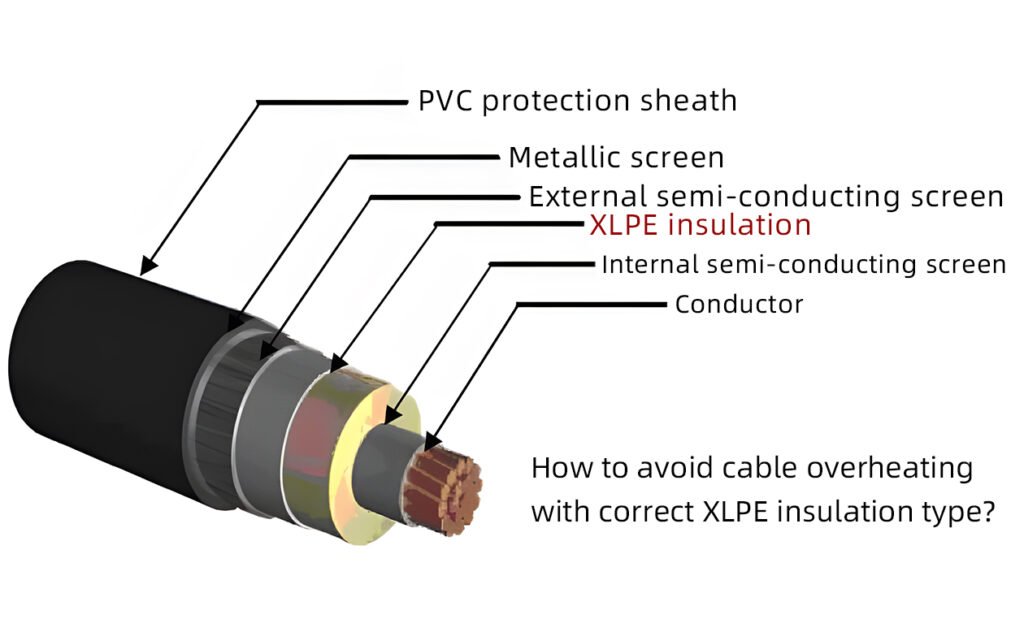
Technical Parameter Comparison: Insulation Material Thermal Profiles
The structural integrity of a power distribution system depends heavily on matching the insulation compound to the projected thermal load. The matrix below contrasts standard XLPE against alternative materials under critical thermal and electrical parameters.
| Technical Parameter | Standard PVC | Silane-Crosslinked XLPE (LV) | Peroxide-Crosslinked XLPE (MV/HV) | Flame-Retardant LSZH XLPE |
| Max. Continuous Conductor Temp. | 70°C | 90°C | 90°C | 90°C |
| Emergency Overload Temp. (Max 100h) | 95°C | 130°C | 130°C | 130°C |
| Short-Circuit Limiting Temp. (≤ 5s) | 160°C | 250°C | 250°C | 250°C |
| Thermal Conductivity (W/m·K) | 0.12 – 0.17 | 0.23 – 0.28 | 0.25 – 0.30 | 0.20 – 0.25 |
| Dielectric Loss Factor (tan δ at 50Hz) | 10⁻² to 10⁻¹ | ≤ 1.0 × 10⁻³ | ≤ 5.0 × 10⁻⁴ | ≤ 5.0 × 10⁻³ |
| Primary Industry Standards | IEC 60502-1 / BS 6346 | IEC 60502-1 / BS 5467 | IEC 60502-2 / ICEA S-93-639 | IEC 60502-1 / BS 6724 |
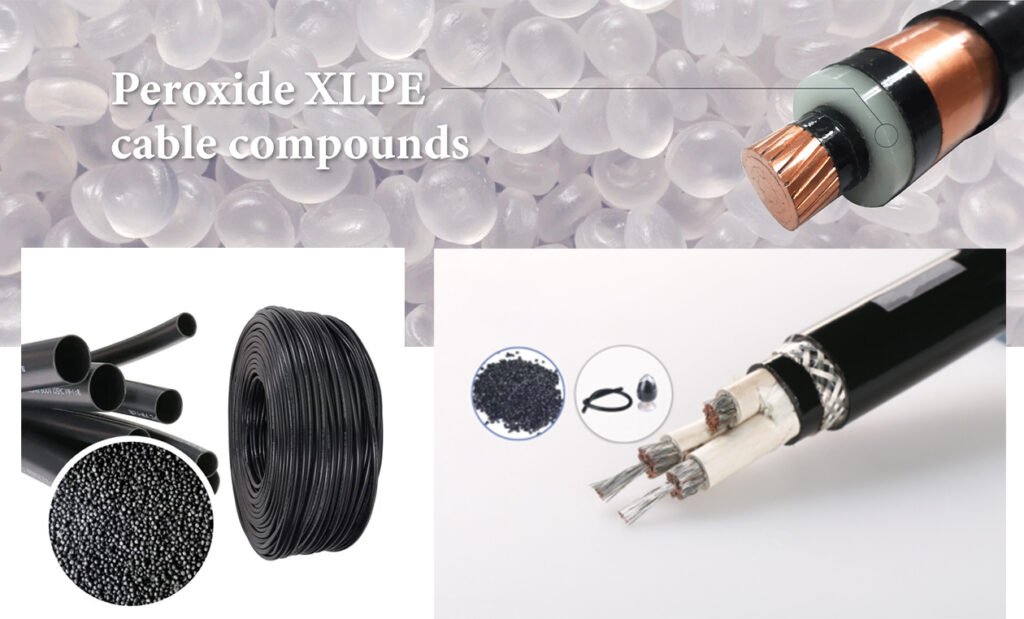
Categorizing XLPE Insulation Types by Thermal Performance
Peroxide Cross-linked XLPE for Medium/High Voltage Stability
Utilizing a high-pressure, high-temperature continuous vulcanization (CV) process with organic peroxides (e.g., dicumyl peroxide), this method achieves a cross-linking degree exceeding 75%. It minimizes micro-voids within the insulation polymer matrix, dropping the dielectric loss factor (tan δ) to exceptionally low levels. This formulation is mandatory for Medium Voltage (MV) and High Voltage (HV) applications where dielectric heating represents a significant component of the total thermal load.
Silane Cross-linked XLPE for Low-Voltage Mechanical Flexibility
Produced via moisture-cure grafting (the Sioplas or Monosil process), silane-crosslinked XLPE delivers optimal thermal performance for low-voltage (LV) power distribution. It maintains a stable 90°C operating threshold while offering superior flexibility and resistance to environmental stress cracking (ESCR). It is highly optimized for complex industrial routings where tight bends are unavoidable.
Flame-Retardant & LSZH XLPE Compounds for High-Density Containment
In poorly ventilated spaces or high-density cable trays, standard XLPE can be modified with zero-halogen flame retardants (metal hydrates like aluminum trihydroxide). While these additives slightly alter the thermal conductivity matrix, the resulting Low Smoke Zero Halogen (LSZH XLPE) prevents thermal cascading—ensuring that if an external fire or localized overload occurs, the insulation suppresses flame spread and toxic gas emission without sacrificing the 90°C continuous thermal limit.