



Annealing Process Impact on Flexible Wire Flexural Performance
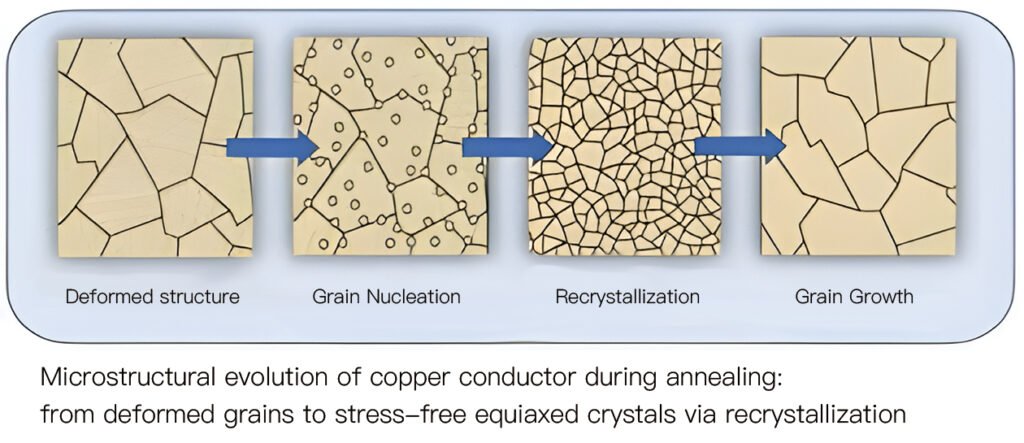
The annealing process directly determines the flexibility of a cable conductor by recrystallizing the elongated, work-hardened crystal grains of drawn copper or aluminum. During cold drawing, the metal’s grain structure becomes highly stressed and elongated, resulting in high tensile strength but severe brittleness and minimal flexibility. Heating the conductor above its recrystallization temperature (typically 200°C to 250℃ for copper) relieves these internal stresses. This process restores ductility, maximizes elongation-at-break parameters, and lowers yield strength, allowing the finished flexible wire (such as Class 5 or Class 6 conductors per IEC 60228) to withstand repeated cyclic bending without micro-cracking or structural failure.
Technical Parameter Matrix: Hard-Drawn vs. Annealed Copper Conductors
The following structural data matrix outlines the mechanical and electrical transformations that occur within the conductor material pre- and post-the annealing process.
| Technical Parameter | Hard-Drawn Copper (Pre-Annealing) | Fully Annealed Copper (Post-Annealing) | Impact on Flexible Wire Performance |
| Electrical Conductivity (% IACS) | ~97.0% to 98.5% | ≥ 100.0% to 102.0% | Minimizes I²R ohmic losses; optimizes current carrying capacity. |
| Tensile Strength (N/mm²) | 400 – 450 | 200 – 250 | Lower yield point permits bending with significantly reduced force. |
| Elongation at Break (%) | < 1.5% to 2.0% | ≥ 25% to 35% (Based on wire diameter) | Allows individual strands to stretch during tight-radius bending without fracturing. |
| Crystal Grain Structure | Elongated, fibrous, high dislocation density | Equiaxed, stress-free, low dislocation density | Eliminates micro-strains; prevents premature fatigue failure during cyclic flexing. |
| IEC 60228 Conductor Class | Class 1 (Solid) / Class 2 (Stranded) | Class 5 (Flexible) / Class 6 (Highly Flexible) | Determines the ultimate application suitability (e.g., trailing cables, robotics). |
Microstructural Mechanics of Flexibility in LSZH and Rubber Sheathed Cables
Grain Recrystallization and Dislocation Density
During the manufacturing of highly flexible wire ropes and trailing cables, individual Annealed Copper strands undergo localized atomic restructuring. The cold-drawing process creates high dislocation densities within the metallic lattice, locking grains in place and rendering the wire stiff.
The thermal energy introduced during annealing allows new, stress-free grain nuclei to form and grow. This low-dislocation, equiaxed grain distribution allows atomic planes to slide past one another effortlessly, granting the wire its characteristic high flexibility.
Compatibility with Polymeric Insulation Matrix
The mechanical properties achieved through proper annealing directly influence the performance of overlying insulation layers such as Flame Retardant Low Smoke Zero Halogen (LSZH) or heavy-duty Elastomeric Rubber.
- Stress Distribution: Unannealed, stiff strands exert non-uniform localized radial forces against the insulation wall during bending, causing accelerated dielectric stress and mechanical shearing.
- Fatigue Synchronization: Fully annealed conductors deform elastically in tandem with flexible PVC or PUR outer sheaths. This synchronization eliminates internal frictional heating between the conductor strands and the insulation boundary layer during high-speed, continuous flexing motions common in automation drag chains.