



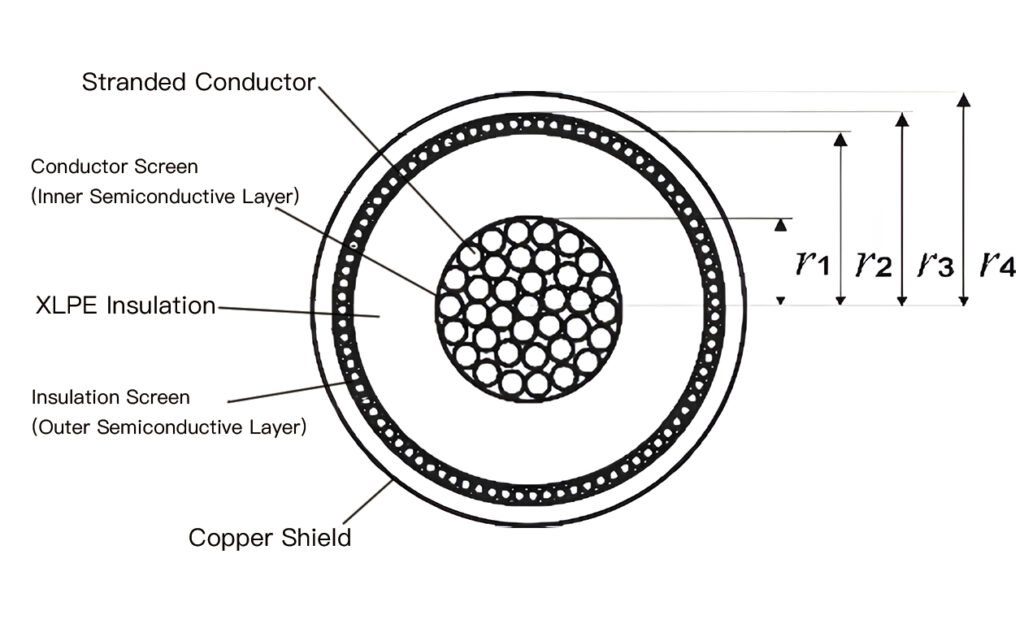
In medium-, high-, and extra-high-voltage power cables, the inner and outer semi-conductive layers (also known as the conductor screen and insulation screen) function as electrical field-smoothing barriers. Because primary cable insulation like Cross-linked Polyethylene (XLPE) is highly sensitive to localized electrical stress gradients, these layers are indispensable for eliminating partial discharges and ensuring a perfectly symmetrical radial electric field.
Typically made of a polyethylene base heavily compounded with conductive Carbon Black, these layers possess an intermediate volume resistivity (10¹ to 10⁴ Ω·cm). This places them electronically between a metallic conductor and a pure dielectric, allowing them to act as equipotential boundaries that encapsulate the insulation wall.
Technical Parameter Matrix: Inner vs. Outer Semi-Conductive Layers
The physical boundaries and distinct application roles for both semi-conductive layers under standards such as IEC 60502-2 are detailed below:
| Technical Parameter | Conductor Screen (Inner Semicon) | Insulation Screen (Outer Semicon) |
| Physical Location | Positioned directly over the stranded metal Conductor. | Positioned between the XLPE insulation and the copper shield/metallic Armor. |
| Electrical Potential | Operates at the same high-voltage potential as the conductor core. | Connected directly to the ground matrix (0 V potential). |
| Primary Electrical Role | Eliminates high-stress points caused by individual wire strand geometries. | Ensures the electric field lines terminate perfectly perpendicular to the ground plane. |
| Mechanical Sub-Function | Absorbs microscopic thermal expansion/contraction of the core strands. | Prevents localized air gaps from forming beneath wrinkled copper shielding tapes. |
| Material Bonding Profile | Always fully bonded (molecularly fused to the inner XLPE wall). | Available as either strippable (cold-peelable) or fully bonded compounds. |
Engineering Physics: Why the Semi-Conductive Layers are Indispensable
1. Function of the Conductor Screen (The Faraday Cage Effect)
If raw XLPE insulation were extruded directly over a standard stranded conductor, the helical profiles of the individual outer wire strands would create an uneven, corrugated surface. Under high voltage, the electric field lines would naturally concentrate at the peaks of these strands due to their sharp radius of curvature.
Furthermore, air-filled micro-voids would become trapped in the valleys between the strands. Because air has a lower relative permittivity than XLPE (εᵣ = 1,0 frente a εᵣ = 2,3), the voltage gradient across these air pockets would be amplified, ionizing the air and triggering destructive Partial Discharge (PD) and progressive Electrical Treeing.
The inner semi-conductive layer addresses this by completely filling the valleys between the strands, presenting a perfectly smooth, cylindrical outer surface to the insulation layer. It acts as a molecular Faraday Cage, eliminating the electric field within the structural valleys and smoothing the field lines out into a uniform, radial path.
2. Function of the Insulation Screen (Confining the Dielectric Field)
The grounded metallic shield (composed of copper wires or tapes) wrapped around the outside of the insulation core also presents geometric irregularities. If the outer shield is directly placed on the insulation, minor bending or flexing of the cable during installation creates milimetric gaps between the insulation and the metal tape.
The outer semi-conductive layer provides a continuous, uniform ground plane directly bonded to the outer perimeter of the XLPE insulation. It eliminates any potential drops across air gaps beneath the metal shield, confining the entire electric field strictly to the interior of the main insulation wall. This ensures that the outer layers of the cable, such as the steel Armor or PVC jacket, remain completely free of dangerous voltage gradients.