


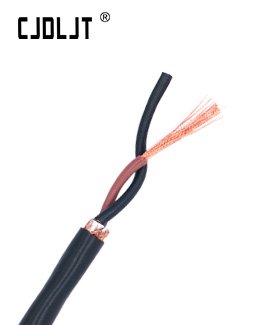

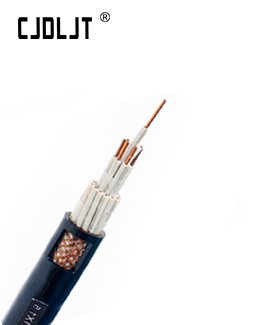
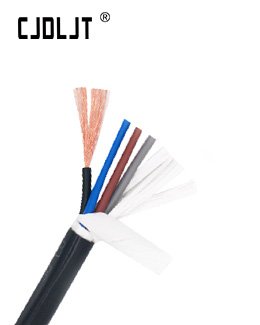
Partial Discharge (PD) is the leading driver of irreversible dielectric degradation and premature failure in medium- and high-voltage cable insulation systems. According to global power utility statistics, over 80% of insulation breakdowns in Cross-linked Polyethylene (XLPE) and PVC cables are preceded by ongoing PD activity.
The impact of PD on insulation life is non-linear, characterized by a prolonged incubation period followed by a rapid, exponential escalation. Once a stable, carbonized partial discharge pathway forms, the residual life of the dielectric matrix degrades exponentially, transforming a system designed for a 30-year operational lifespan into a catastrophic short-circuit fault within months or even days.
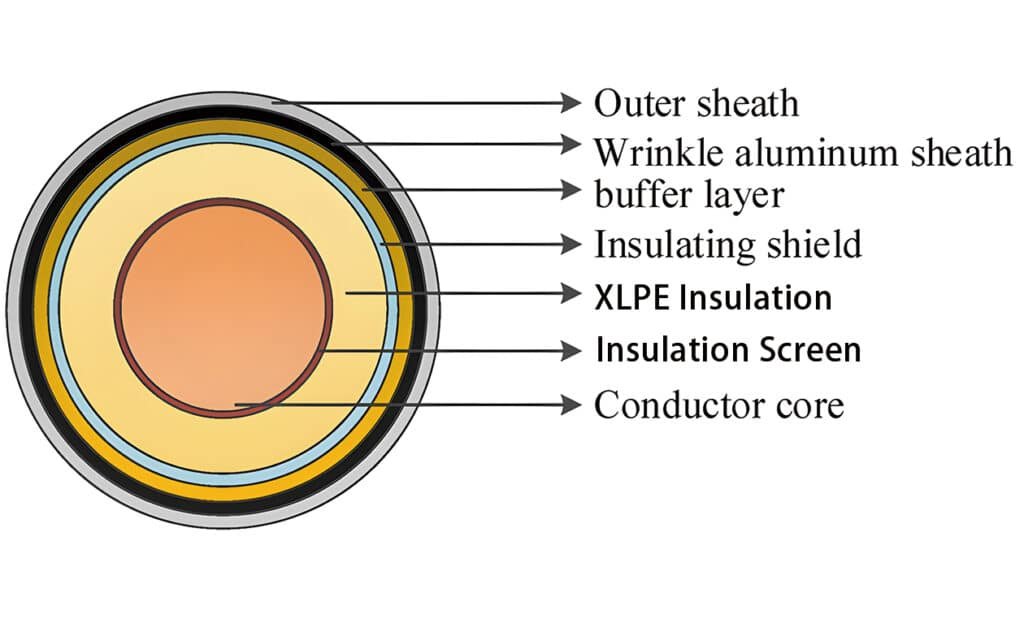
Technical Parameter Matrix: PD Impact on Insulation Lifespan
Different types of partial discharge degrade polymer structures at vastly different rates due to their specific physical mechanisms and locations within the cable architecture.
| PD Category | Typical Charge Range | Primary Degradation Byproducts | Degradation Rate / Threat Level to Lifespan |
| Internal (Void) Discharge | 5 pC – 500 pC | CO, CO₂, conductive carbon, micro-moisture | Extreme (Fatal): Trapped within the XLPE bulk; heat and gases cannot dissipate, rapidly initiating treeing. |
| Interface Discharge | 100 pC – 2000 pC | Oxalic acid, ozone, conductive tracking paths | High (Acute): Occurs at cable joints/terminations; leads to rapid surface tracking and phase-to-phase flashovers. |
| Corona Discharge | 10 pC – 100 pC | Ozone (O₃), Nitrous oxides (NOₓ), nitric acid | Moderate (Progressive): Corrodes exposed termination components, eroding insulation from the outside inward. |
Degradation Mechanics: How PD Erodes Polymer Insulation
Partial discharge destroys the long-term molecular integrity of cable dielectrics through a combination of localized chemical, thermal, and mechanical stresses.
1. High-Energy Particle Bombardment
Gas ionization within an insulation defect accelerates free electrons and ions under the intense localized electric field. These high-energy particles continuously bombard the surrounding XLPE or PVC matrix. Their kinetic energy regularly exceeds the covalent bond energies of the polymer backbone—specifically the Carbon-Carbon (C-C, ≈ 3.6 eV) and Carbon-Hydrogen (C-H, ≈ 4.2 eV) bonds—causing immediate chain scission, molecular weight reduction, and structural fracturing.
2. Micro-Zone Thermal Pyrolysis
Although the macro-energy profile of a single PD pulse is minute, the discharge hit-zone is microscopic. During the nanosecond-range discharge pulse, the instantaneous power density at the impact point spikes dramatically, generating localized temperatures of several hundred degrees Celsius. This microscopic thermal stress melts and gasifies the surrounding polymer, leaving behind conductive carbon tracking paths (graphitization) that act as microscopic needle electrodes within the cable core.
3. Chemical Acidification and Oxidation
PD activity in trapped air pockets breaks down oxygen and nitrogen molecules, creating ozone (O₃) and interacting with trace ambient moisture to form highly corrosive nitric acid (HNO₃). These aggressive oxidizing agents attack the unstable free radicals created by polymer chain scission, accelerating material embrittlement, stress cracking, and the physical peeling of the cavity walls.
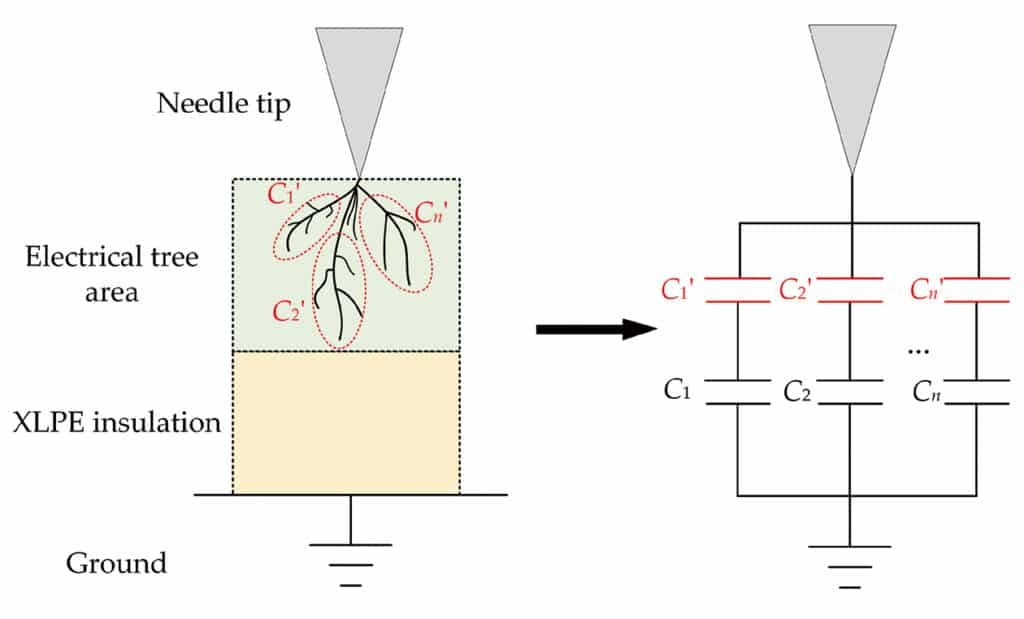
4. Electrical Treeing Propagation
As the cavity wall degrades, microscopic carbonized pits develop. These sharp pits distort the local geometry, amplifying the electric field gradient (Eₘₐₓ) at the tip of the defect:
Eₘₐₓ ≈ 2V / [r・ln (1 + 4d/r)]
Where r represents the defect tip radius and d is the remaining insulation thickness. When Eₘₐₓ exceeds the dielectric strength of the polymer, microscopic conductive channels shoot outward in a branched structure known as Electrical Treeing. Once initiated, the tree grows autonomously at an accelerating rate until it bridges the gap between the primary conductor and the ground screen, causing an instantaneous dielectric breakdown.