

Difference in Oxidation Resistance Between Tin-Plated and Bare Copper Conductors
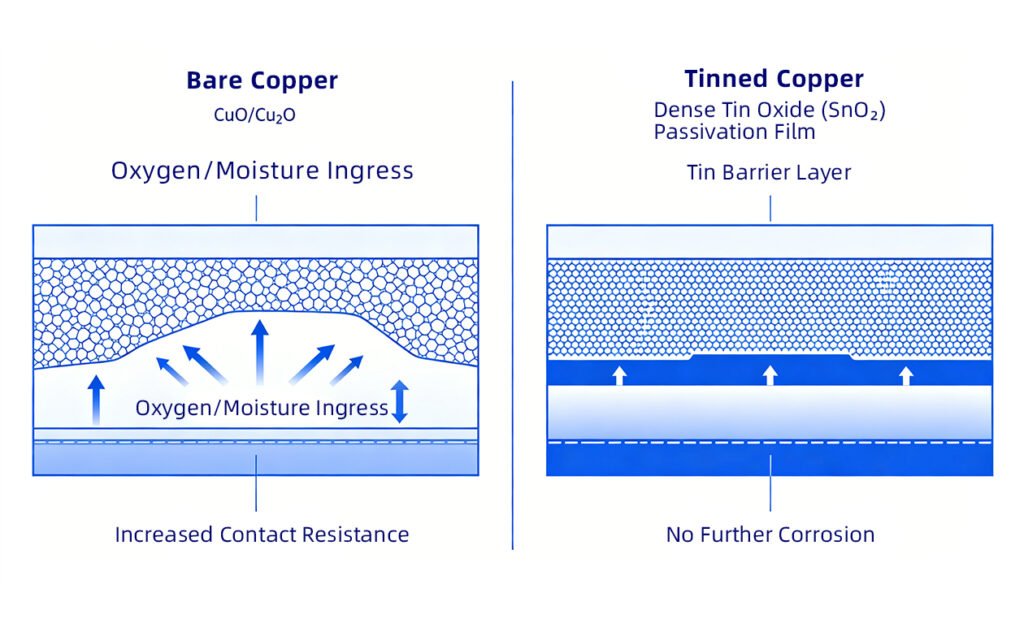
Tin-plated copper conductors exhibit significantly higher oxidation resistance than bare copper conductors, particularly in high-temperature, humid, or corrosive environments. Bare copper reacts with atmospheric oxygen and moisture to form copper oxide ( or ), which increases contact resistance and accelerates degradation. Tin-plating creates a sacrificial and protective barrier via a tin layer that undergoes passivation, forming a stable oxide film () that halts further atmospheric corrosion. According to ASTM B33 and IEC 60228, tinning preserves the solderability and electrical conductivity of the underlying annealed copper over an extended operational lifespan.
Technical Parameter Comparison
The following data matrix outlines the performance metrics of tin-plated versus bare copper conductors under various stress conditions.
| Technical Parameter | Tin-Plated Copper Conductor | Bare Copper Conductor | Standard Reference |
| Oxidation Resistance | High (Forms stable passivation layer) | Low (Formulates progressive scale) | ASTM B33 / ASTM B3 |
| Max Continuous Operating Temp | Up to 150°C (Depending on insulation) | Typically limited to 100°C to prevent rapid oxidation | IEC 60502-1 |
| Corrosion Resistance (Sulfate/Moisture) | Excellent (Resists sulfur-induced corrosion) | Poor (Prone to “green plague” or copper carbonate) | DIN VDE 0295 |
| Long-term Solderability | Excellent (Maintained over extended storage) | Poor (Requires aggressive fluxing after oxidation) | IPC/EIA J-STD-002 |
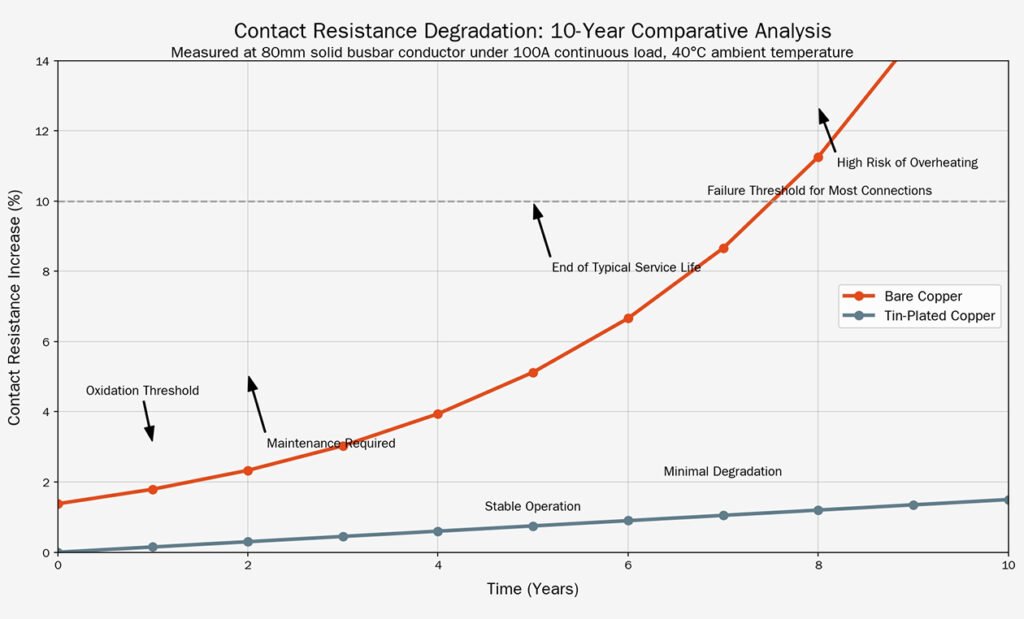
| Contact Resistance Over Time | Stable (Low intermetallic degradation) | Exponentially Increasing (Due to non-conductive oxide layer) | BS EN 60228 |
Mechanism of Atmospheric Degradation in Copper Conductors
Bare Copper Oxidation Kinetics
When exposed to ambient air, bare annealed copper undergoes a direct chemical reaction with oxygen. Initially, cuprous oxide () forms, followed by cupric oxide (). This layer is porous and brittle. As electrical current flows, the localized heating accelerates the oxidation rate exponentially, leading to degradation of the electrical path and localized thermal runaway at termination points.
Tin Passivation Barrier
The application of a uniform tin layer via electroplating or hot-dipping creates a barrier typically 1 to 5 microns thick. Tin possesses a high affinity for oxygen, rapidly creating a microscopic, dense layer of tin dioxide (). Unlike copper oxide, this passivation layer is non-porous and structurally stable, completely sealing the underlying copper from oxygen migration and galvanic corrosion.