



Stranding Pitch Optimization and Cable Kinematics
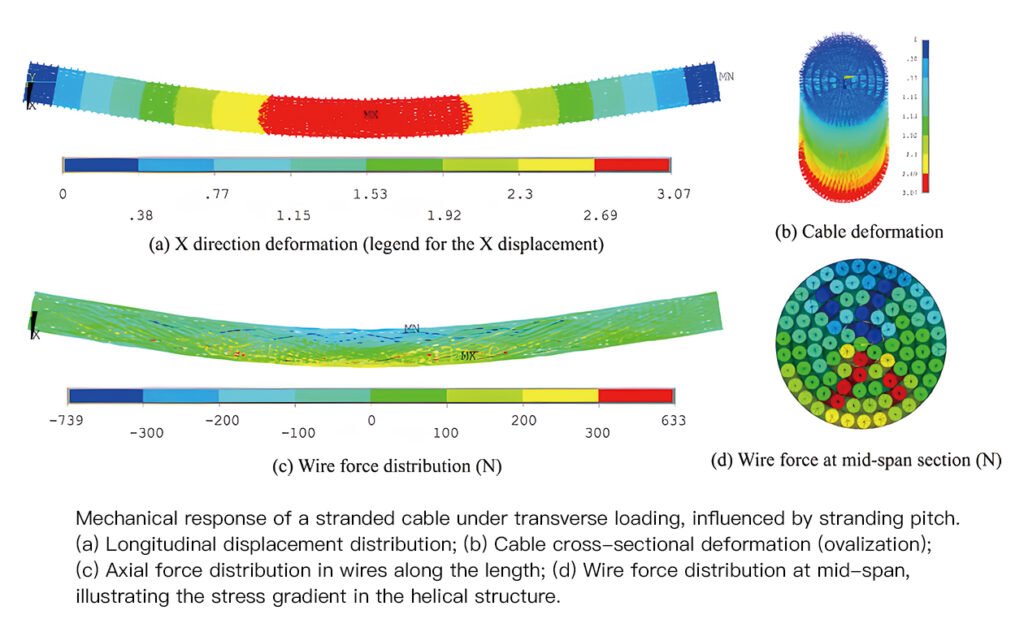
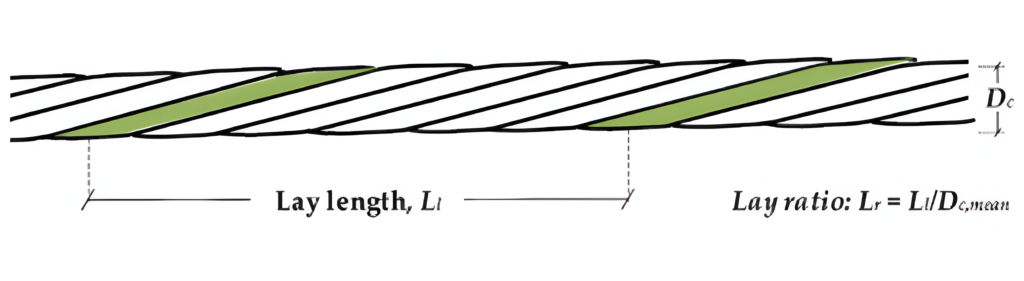
The stranding pitch—commonly defined as the axial length required for a single insulated conductor or strand to complete one full 360 °C helical revolution around the cable core—is a critical geometric variable in the cabling process. It directly determines the mechanical stability, tortional balance, and electrical performance of multi-core power, control, and data cables. Altering the pitch ratio (the ratio of lay length to the assembled core diameter) changes the internal vector forces experienced by individual elements. Shorter stranding pitches increase the structural integrity and flexibility of the cable assembly by converting longitudinal bending stresses into compressive and tensile forces distributed uniformly across the helical structure, preventing localized buckling or “bird-caging” under cyclic stress.
Technical Parameter Matrix: Short Pitch vs. Long Pitch Performance
The following structural data matrix contrasts the technical performance trade-offs inherent in stranding pitch selection during the cable layout process.
| Performance Metric | Short Stranding Pitch (< 10x Core OD) | Long Stranding Pitch (> 16x Core OD) | Impact on Cable Functionality |
| Mechanical Flexibility | Exceptional; low bending resistance. | Poor; high stiffness, prone to kinking. | Determines suitability for dynamic drag chains vs. fixed installations. |
| Tensile Load Capacity | Reduced axial strength; elongation risk. | Maximum axial strength; minimal elongation. | Affects structural integrity during high-tension vertical installations or towing. |
| Crosstalk & EMI Mitigation | Superior attenuation due to balanced geometry. | Inferior; prone to signal phase disparities. | Critical for data integrity in twisted-pair or instrumentation shielding. |
| Material Consumption | High copper/insulation take-up factor (k-factor). | Low take-up factor; closely matches linear length. | Directly impacts raw material manufacturing costs and cable weight. |
| Production Line Throughput | Lower line speed (high rigid-frame RPM required). | Higher line speed; optimized manufacturing efficiency. | Governs processing parameters on the planetary or drum twister. |
Engineering Impact on Mechanical Integrity and Signal Transmission
Tensile Stress Distribution and Micro-Slip Mechanics
When a multi-core cable is subjected to bending, cores situated on the outer radius experience tensile stress, while inner cores undergo compression. A precise stranding pitch allows individual insulated conductors to shift via micro-slip mechanics within the assembly, neutralizing these opposing forces.
If the pitch is too long, the conductors cannot slip effectively, leading to high tensile loads that deform the Annealed Copper strands and shear the PVC or XLPE insulation matrix.
High-Frequency Signal Integrity and Crosstalk Elimination
In data and telecommunication cabling, stranding pitch—frequently termed pair twist lay—is the primary mechanism for canceling electromagnetic interference (EMI).
- Capacitive Unbalance Reduction: Alternating and tightly controlling the pitch length between adjacent pairs prevents magnetic coupling. This ensures that external noise affects both conductors in a pair equally, enabling total common-mode noise rejection at the receiver end.
- Structural Return Loss (SRL) Control: Variations in the stranding pitch create impedance discontinuities. Maintaining pitch uniformity through high-precision tension control on the cabling line is mandatory to satisfy the strict structural return loss limits set by TIA/EIA-568 and ISO/IEC 11801 standards.