



Why Concentricity Control Matters in Cable Insulation Extrusion
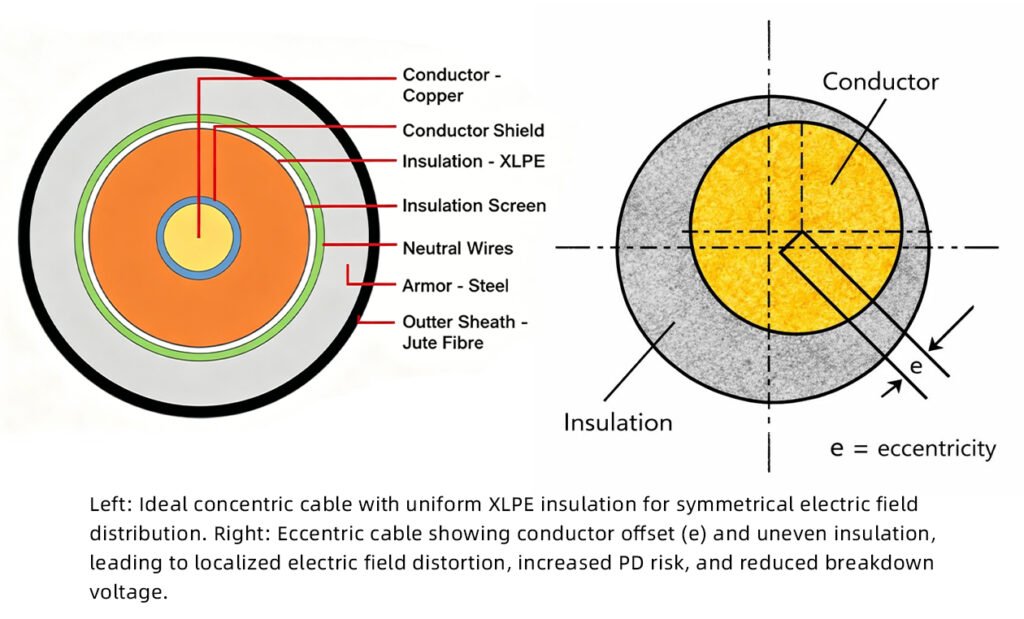
Concentricity control in cable insulation extrusion ensures that the conductor rests precisely in the geometric center of the insulating layer (such as XLPE, PVC, or LSZH). Maintaining a high concentricity ratio—ideally above 90%—is critical to preventing electrical and mechanical asymmetry. If the insulation wall thickness becomes uneven (eccentric), the thinnest point creates a localized path of least resistance. Under high voltage stress, this vulnerable area risks dielectric breakdown, partial discharge, and ultimate cable failure. Precise concentricity maximizes electrical safety, ensures compliance with IEC 60502 standards, and optimizes material utilization during high-speed manufacturing.
Technical Parameter Matrix: Concentricity vs. Cable Performance
The table below illustrates how variance in concentricity levels directly impacts critical mechanical, electrical, and operational parameters of a 0.6/1 kV rated power cable.
| Technical Parameter | Optimal Concentricity (≥90%) | Marginal Concentricity (75%−89%) | Poor Concentricity (<75%) |
| Dielectric Breakdown Voltage | Matches or exceeds rated limits. | Reduced by 15% to 30% at the thinnest wall point. | High risk of immediate failure during high-voltage AC withstand testing. |
| Partial Discharge (PD) Risk | (per IEC 60502-2). | Elevated PD activity due to localized electric field distortion. | Severe localized electrical stress causing rapid treeing degradation. |
| Stripping & Termination Efficiency | Clean, uniform stripping via automated scoring tools. | Risk of scoring or nicking the Annealed Copper conductor. | High probability of conductor damage; manual adjustment required. |
| Raw Material Waste Rate | Optimized; adheres strictly to nominal insulation thickness. | Moderate material giveaway to ensure minimum wall thickness compliance. | Significant compound waste (5% to 12% excess) to compensate for eccentricity. |
Electrical Engineering Implications of Eccentricity
Dielectric Stress and Electric Field Distortion
When an insulated cable is energized, the electric field lines radiate from the central conductor to the outer shield or environment. In a perfectly concentric cable, the potential gradient () is uniform across the circumference.
If eccentricity occurs, the electric field becomes concentrated at the thinnest point of the insulation according to the following relationship for coaxial cables:
Where is the applied voltage, is the conductor radius, and is the outer insulation radius. When decreases locally due to poor concentricity, the localized electric field gradient () increases sharply, accelerating the aging of the XLPE or Flame Retardant compound.
Mechanical Integrity During Installation
Cables with poor concentricity exhibit asymmetrical structural rigidity. During installation, when the cable is pulled around a conduit bend, the thin-walled side is highly susceptible to structural deformation, tearing, or crushing under tension.
- Bending Radius Standard: To protect uneven insulation from mechanical failure, cables with compromised concentricity require a bending radius up to 20x the cable outer diameter, whereas concentric cables safely achieve 15x the cable outer diameter under BS 5467 guidelines.
Global Compliance and Testing Standards
IEC 60502-1 Clause 16.5 Requirements
International manufacturing standards mandate strict compliance regarding insulation thickness measurements. Under IEC 60502-1, the minimum thickness at any single point () must not fall below of the nominal thickness ():
Impact on Flame Retardancy and LSZH Performance
For Low Smoke Zero Halogen (LSZH) and fire-resistant cables, concentricity control is a critical factor in passing the IEC 60332 flame propagation tests. If a flame interacts with the thin-walled side of an eccentric cable, the insulation breaches rapidly, exposing the core conductor to short-circuits long before the nominal fire-resistance duration (e.g., 90 or 120 minutes) is achieved. Uniform wall thickness guarantees an equal thermal barrier around the entire perimeter of the cable.