



Performance of ACSR Conductors in Coastal Corrosive Environments
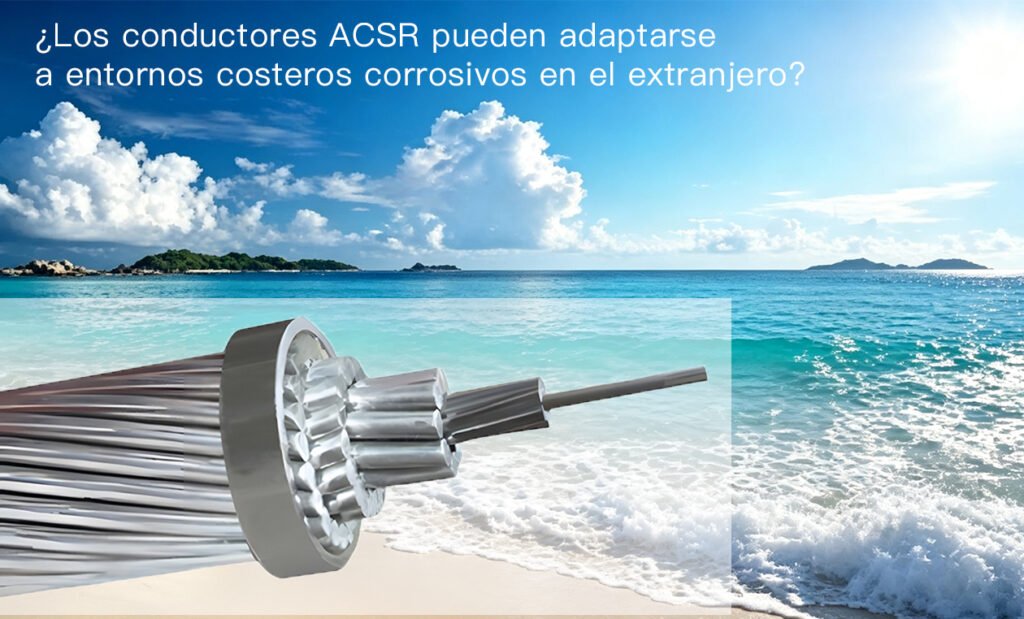
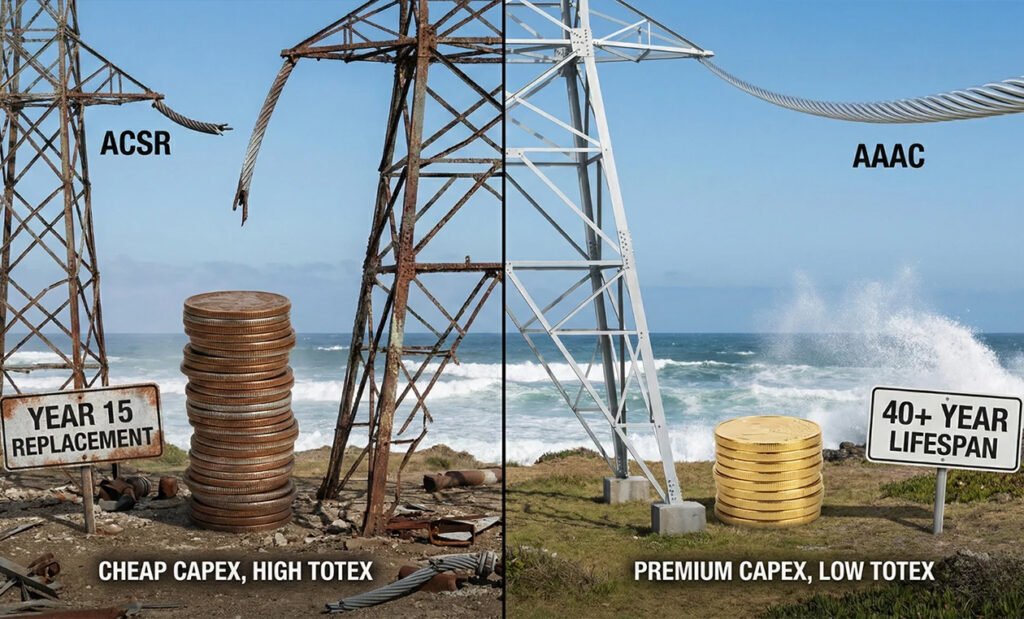
Standard ACSR (Aluminum Conductor Steel Reinforced) conductors have limited inherent adaptability to coastal corrosive environments due to galvanic corrosion. When exposed to marine atmospheres containing high chloride concentrations (Cl⁻) and moisture, the potential difference between the outer aluminum strands and the inner zinc-coated (galvanized) steel core forms an active galvanic cell. This accelerates the degradation of the aluminum layers, reducing both cross-sectional area and mechanical structural integrity. To adapt ACSR for overseas coastal deployment, manufacturers must apply specialized anti-corrosion structural modifications, such as high-temperature core greasing, zinc-5% aluminum-mischmetal (Zn-5Al-MM) alloy coatings, or transition to AAAC (All Aluminum Alloy Conductors).
Technical Parameter Matrix: Corrosive Environment Adaptation
The matrix below evaluates how various bare overhead conductor variants perform under intense marine atmospheric conditions according to IEC 61089 and ASTM B232/B232M benchmarks.
| Conductor Configuration | Corrosion Resistance Rating | Core Protection Mechanism | Mechanical Tensile Strength | Service Life Expectancy (Coastal) | Critical Engineering Limitations |
| Standard ACSR | Low | Standard Zinc Galvanizing (Zn) | Very High | 10 – 15 Years | Rapid galvanic corrosion once zinc sacrificial layer depletes. |
| Greased ACSR (Class A/B/C Grease) | Medium-High | High-Drop-Point Hydrophobic Grease Layer | Very High | 25 – 30 Years | Temperature-limited; grease can migrate or degrade above 90°C. |
| ACSR/AZ (Aluminized Core) | High | Hot-Dip Aluminum Coating (Al) | High | 30 – 40 Years | Slightly lower initial tensile strength than high-tensile galvanized steel. |
| ACSR/Galfan (Zn-5Al-MM) | High | Zinc-5% Aluminum-Mischmetal Alloy | Very High | 35 – 45 Years | Higher manufacturing costs; strict stringing tension controls required. |
| AAAC (6201-T81 Alloy) | Maximum | Homogeneous Alloy (No Galvanic Interface) | High | 40+ Years | Lower ultimate tensile strength compared to heavy-core ACSR variants. |
Alternate Conductor Structural Solutions for Coastal Tracks
All Aluminum Alloy Conductors (AAAC)
AAAC manufactured from 6201-T81 aluminum-magnesium-silicon alloy provides an optimal alternative in coastal distribution networks. Because the conductor cross-section is entirely homogeneous, it eliminates the internal galvanic potential difference inherent to steel-reinforced cables. AAAC delivers up to 90% of the tensile strength of standard ACSR while exhibiting superior resistance to saltwater pitting.
Advanced Core Coating Alloys (ACSR/Galfan)
For long-span transmission crossings over saltwater bays or estuaries where high mechanical tension is mandatory, specify ACSR utilizing a Zn-5Al-MM (Galfan) alloy core coating instead of standard galvanizing. This multi-phase alloy layer forms a passive barrier that provides up to three to four times the corrosion protection of a standard zinc coating under salt spray testing conditions (ASTM B117).